Ad Blocker Detected
Our website is made possible by displaying online advertisements to our visitors. Please consider supporting us by disabling your ad blocker.
We’re looking at budget water ionizers that deliver real value without breaking the bank, balancing multi-stage filtration, durable builds, and solid warranties. We’ll compare models that fit under-sink or countertop setups, offer reliable maintenance guidance, and keep ongoing costs in check. There are trade-offs to evaluate, from filtration stages to plate materials and self-cleaning options. Let’s explore what makes these five options stand out—and why the right choice matters for long-term reliability.
Key Takeaways
- Look for models with multi-stage filtration (sediment/ceramic, activated carbon, mineral/ion-exchange) to balance performance and cost.
- Prioritize compact, under-sink or countertop ionizers with universal voltage and install flexibility for savings.
- Check durability and components (stainless/robust plastics, titanium/platinum plates) for long-term reliability.
- Favor ionizers with clear maintenance plans, self-cleaning features, and affordable replacement parts.
- Consider total cost: upfront price plus membrane/filter longevity and solid warranty/support.
Ionized Alkaline Water Filter with 8-Stage Filtration


Looking for real value without sacrificing filtration power? We present the Ionized Alkaline Water Filter with 8-Stage Filtration. We combine under-sink or countertop setup with seven advanced media plus minerals, delivering purified, taste-enhanced water. Our first stage uses a ceramic filter removing 99.99% of contaminants, then ion exchange resins soften hardness, and activated carbon removes chlorine and odors. Alkasing minerals mineralize gently, while FIR beads energize water. KDF and carbon tackle heavy metals and bacteria, and magnetic stones aim to improve p-water readings. With pH nudged to 7.2–7.5, you gain mineral balance and smoother taste in every glass.
Best For: Individuals seeking a multi-stage under-sink or countertop filtration system that targets taste, chlorine, and hardness while adding minerals and mild alkalinity.
Pros:
- Comprehensive 8-stage filtration aiming to remove contaminants, chlorine, odors, and heavy metals.
- Mineral infusion and mild pH increase to 7.2–7.5 for improved taste and potential wellness benefits.
- Flexible installation (under-sink or countertop) with multiple media designed to enhance water quality and sensation.
Cons:
- Some claims (e.g., FIR energy, p-water) are difficult to verify scientifically and may rely on marketing language.
- Product data includes incomplete details (e.g., weight, dimensions, ASIN/date info), which may affect fit and compatibility checks.
- Complex multi-media system may require regular maintenance and filter replacement to maintain performance.
Hydrogen Bottle Generator Portable Water Machine Turquoise

The Hydrogen Bottle Generator Portable Water Machine Turquoise stands out for on-the-go hydration, pairing a compact 296 ml bottle with a built-in 1-cell Lithium Polymer battery and OLED display that shows real-time hydrogen concentration and timer. We see it as a portable, battery-powered solution using SPE/PEM tech to deliver about 3000ppb hydrogen-infused water. Built with premium, durable materials, it offers a safe vent system and includes a Nasal Cannula Inhaler, power cord, and manual. With the model HWB2023 in turquoise, its 367 g frame travels easily, while the device supports wellness, hydration, and potentially faster recovery for active users. Lifetime warranty.
Best For: Hydration-focused athletes and wellness enthusiasts who want portable, hydrogen-rich water on the go with a compact 296 ml bottle and real-time hydrogen readings.
Pros:
- Portable and lightweight with a built-in battery for on-the-go use
- OLED display shows real-time hydrogen concentration and timer for easy monitoring
- Includes safety features like a built-in vent system and comes with a nasal cannula inhaler
Cons:
- 296 ml capacity may require frequent refills during extended activities
- Battery-powered operation requires charging and may limit use without access to power
- 3000 ppb hydrogen concentration may vary with water source and usage conditions
New Design! – Tyent ACE-13 Water Ionizer
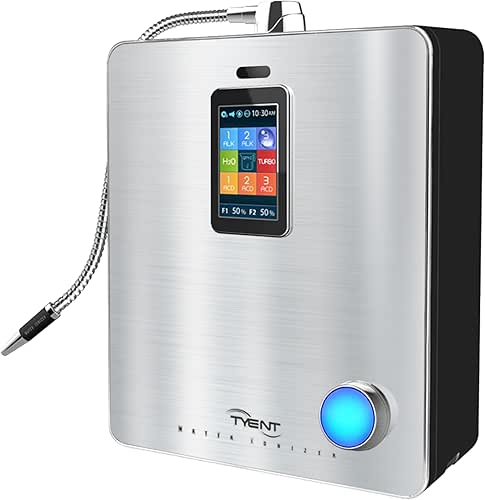
The Tyent ACE-13 stands out with its new design and 13 solid/mesh hybrid plates, delivering efficient ionization in a compact above-counter unit. We highlight its 13 plates, 10 Amps power, and SMPS for stable operation. This model, by TYENT, arrives in a silver finish and measures about 29.97 by 13.46 by 35.31 cm, weighing 7.12 kg. It features a Change Filter Indicator and above-counter installation for easy setup. Packaging shows no batteries required, with a 30-day return window via Amazon policy. Availability notes include ASIN B07VN9H15T and a single-unit carton. Overall, it blends design with practical specs.
Best For: Those seeking a compact, above-counter ionizer with a 13-plate setup and reliable TYENT build for home use.
Pros:
- 13 solid/mesh hybrid plates for efficient ionization
- Compact above-counter design with convenient installation
- 10 Amps power and SMPS for stable operation
Cons:
- Higher weight (7.12 kg) may be less suitable for frequent repositioning
- Only one unit per carton; limited quantity per order
- No batteries required or included (requires external power)
Water Ionizer & Purifier with Auto-Cleaning, Silver

For budget-conscious buyers who want reliable, high-efficiency ionization without breaking the bank, this Water Ionizer & Purifier with Auto-Cleaning in Silver stands out. We review its 7 water settings, 4 alkaline, 2 acidic, plus purified water, with ORP from +600 to -500 mV. We value the 5 titanium plates, platinum coating, and Japan-imported membrane for durable electrolysis and longevity. The self-cleaning function reduces scaling, while the 3.8-inch LCD and touch panel simplify operation for all ages. With under-sink installation, universal 110–220V power, and clear filter life displays, it blends performance with practical, cost-conscious design.
Best For: Budget-conscious buyers seeking reliable, high-efficiency ionization with broad voltage compatibility and user-friendly, under-sink installation.
Pros:
- 7 water settings including 4 alkaline, 2 acidic, and purified water, with wide pH and ORP ranges for versatility
- Self-cleaning function and filter-life display simplify maintenance and longevity
- 3.8-inch color LCD touch panel and under-sink setup make operation easy for all ages
Cons:
- Certifications and claims may vary by region; ensure local compatibility and duties if importing from China
- Limited physical dimensions and weight could influence installation space planning
- Higher upfront cost relative to basic water purifiers, though marketed for durability and performance
Silver Alkaline Water Ioniser
If you’re shopping on a budget and want reliable ionised and acidic water on demand, the Silver Alkaline Water Ioniser (aQuator Silver) stands out for families who value speed and ease of use. We’ve got a compact, silver unit that’s safe, economical, and simple, with an LCD in Russian or German and clear LEDs. Highlights include ionised alkaline water up to 2.15 L, acidic water up to 0.75 L, and silver water up to 2.9 L in seconds, plus a desion disinfectant mode. Membranes last a year, and new ones are purchasable; auto-shutoff keeps routines efficient.
Best For: families and budget-conscious users who want reliable ionised and acidic water on demand with a compact, easy-to-use device.
Pros:
- Fast production of multiple water types (alkaline, acidic, and silver water) with auto-shutoff for convenience
- Compact, silver unit with LCD in Russian or German and clear LEDs for easy operation
- Membranes last a year and are replaceable, keeping long-term maintenance economical
Cons:
- Output limits may not meet high-demand households needing larger volumes at once
- LCD language options are limited to Russian or German, which may not suit all users
- Requires placement and handling of silver electrode and inner container, adding a bit of setup time between uses
Factors to Consider When Choosing Budget Water Ionizers
We start by weighing price-to-performance value, so you get the most usable features for your budget. We’ll look at filtration stages, build quality, installation flexibility, and how easy it is to maintain over time. Together, we’ll compare maintenance needs and the expected lifespan to help you choose with confidence.
Price-to-Performance Value
When weighing budget water ionizers, price-to-performance boils down to how much filtration and plate technology you get for each dollar. We compare price against filtration capability and plate counts or advanced FIR/H2 features to justify higher costs. We also weigh energy efficiency and operating costs, since electrolysis plates, warranty terms, and filter lifespans shape long-term value. Capacity and flow rate matter too; a larger volume per cycle and faster purification improve cost-per-liter. Maintenance costs—replacement membranes, filters, and electrode longevity—shape total value over time. Bundled warranties and solid support protect your investment and boost price-to-performance over the product’s lifespan. In short, value emerges when upfront cost aligns with durable performance, reliable service, and manageable upkeep.
Filtration Stages Offered
Filtration stages in budget water ionizers typically start with a sediment or ceramic pre-filter to trap particulates, then use activated carbon to remove chlorine and odors, and often include mineral or ion-exchange stages to adjust hardness or add minerals. In practice, many models add Far Infrared or energy-boosting beads to purportedly energize water and reduce cluster size, though results vary. A multi-stage design often ends with a carbon or KDF stage to inhibit heavy metals and microbial growth, boosting taste and safety. The common 4–6 stage setup aims to balance contaminant removal with mineralization and pH adjustment toward mild alkalinity. Since composition and order affect taste, mineral content, and pH, comparing stage-by-stage specs is essential for budget selections.
Build Quality Matters
Is build quality really worth the extra cost when choosing a budget water ionizer? We think so. Build quality directly affects longevity and reliability, with solid materials like stainless steel or robust plastics reducing wear from repeated electrolysis cycles. Higher-grade components—durable titanium plates and platinum coatings—typically withstand corrosion and scaling better over time. A sturdy enclosure and secure internal mounting minimize vibration and leaks, helping maintain consistent electrolysis performance. Precise manufacturing tolerances in seals and fittings reduce the risk of water leakage and inconsistent pH/ORP outputs. Clearage of internal components—self-cleaning cycles and accessible filtration—correlates with longer device life and lower maintenance costs. In short, better construction yields steadier results and lasting value.
Installation Flexibility Options
Installation flexibility matters because your budget ionizer should fit your space and routine, not force you to rearrange the kitchen. We look for models that offer under-sink or countertop mounting to match existing setups and space constraints. Universal power compatibility (110V–240V) helps you skip regional adapters and keeps installation simple. Prefer units with above-counter or inline faucet options to suit different kitchen layouts. It’s also important that the system supports easy relocation or temporary setups for travel or office use, so you aren’t tied down. Clear guidance on required clearances and mounting hardware ensures versatile placement without guesswork. With these checks, you’ll choose a unit that installs smoothly and adapts as your needs change.
Maintenance and Lifespan
Maintenance and lifespan go hand in hand after you pick a budget water ionizer. We know maintenance frequency varies by system, but most setups need filter changes every 6–12 months and occasional membrane or electrode checks based on usage and water quality. Key components like titanium plates or ceramic filters can last several years with proper care, yet performance may decline without timely replacements. Self-cleaning features help cut scale buildup, but they can drive more frequent filter changes due to higher filtration demand. Replacement parts—filters, membranes, electrodes—affect total ownership cost, so availability and price matter. Water source quality—hardness, sediment, chlorine—directly affects maintenance intervals and component wear, shaping long-term reliability. Choosing a unit with affordable parts and manageable maintenance keeps life-cycle costs sensible.
Certification and Safety Standards
When choosing a budget water ionizer, start by confirming trusted safety and quality certifications, like NSF and WQA, to guarantee independent testing of claims and materials. We look for recognized certifications that indicate objective evaluation of performance and construction. Verify the device complies with electrical standards, such as universal voltage (110V–220V), ensuring safe operation in your region. Check for documented approvals specific to water treatment claims, like halogen/chlorine reduction and heavy metal removal, to validate filtration performance. Ensure a clear warranty and a standardized return policy (e.g., 30 days) as part of manufacturer safety and customer protection. Finally, review installation, operation, and maintenance notices to maintain certification validity and safe use.
Frequently Asked Questions
How Long Do Budget Ionizers Last With Typical Use?
We expect budget ionizers to last about 2 to 5 years with typical use, depending on maintenance, water hardness, and filter changes, and we’ll help you choose models that maximize lifespan and reliability for your needs.
Do They Require Professional Installation or DIY Setup?
We investigated installers’ claims and find DIY setup usually works, but some units benefit from professional hookup. We’ll guide you step by step, emphasize safety, and note minor plumbing tweaks may be needed for a clean, secure install.
Is There Warranty Coverage for Affordable Models?
Yes, affordable models usually include a warranty, often one to two years, sometimes longer for parts; we’re careful to read the fine print, compare coverage, and register promptly so you’re protected if issues arise.
Can Budget Ionizers Replace a Water Filter Entirely?
We can’t replace a water filter entirely. Budget ionizers don’t remove all contaminants the way a filter does; use them alongside a proper filtration system for best safety and taste, then enjoy improved pH and minerals.
Are Maintenance Costs Higher for Cheaper Units?
Yes, cheaper units generally have higher maintenance costs over time due to cheaper components and shorter lifespans. We’ll balance upfront price against long-term service needs, replacing parts less often and choosing models with readily available, affordable replacements for you.
Conclusion
We’ve checked the options and know there’s no magic shortcut to pure peace of mind. If we want long-term value, we’ll pick models with solid filtration, durable plates, and dependable support, even if the upfront price isn’t the lowest. We’ll test maintenance routines, confirm universal power, and verify parts availability. By balancing cost now with reliability later, we’re more likely to trust the water we drink and feel confident in our choice.